Who Are the Best Power Converter Manufacturers in China?
Choosing a power converter manufacturer in China is not simply a search for the lowest quote. Buyers also need dependable performance, clear technical documents, and responsive support. A converter may look suitable on a product page, yet behave differently under heat, vibration, or changing loads. Details matter.
This guide examines how to identify manufacturers worth considering. It focuses on practical evidence: published specifications, quality-control procedures, testing capabilities, product range, and communication during sample evaluation. For example, a buyer can compare rated output, efficiency, operating temperature, protection features, and test reports before requesting a quotation. Ask how the supplier handles design changes and production consistency, too. These questions reveal more than a polished catalogue.
“Best” depends on the application. A company serving industrial automation may not suit medical equipment or renewable-energy systems. Some suppliers specialize in standard models; others offer custom designs and engineering support. Neither approach is automatically better. Verify relevant certifications and claims directly, and confirm that the proposed model matches your intended use. A certificate alone does not prove every unit will perform as expected.
This comparison is a starting point, not a substitute for technical review. Even careful research can miss important details. Share operating requirements, request documentation, and test samples under realistic conditions. That extra work can prevent costly surprises later.
Power Converters Explained: AC–DC, DC–DC, and DC–AC Conversion
Power converters reshape electrical energy for the equipment that needs it. AC–DC converters turn alternating current from a wall outlet into direct current for electronics. A phone charger is a familiar example. Its small circuit must manage voltage, current, and heat in a tight space.
DC–DC converters adjust one DC voltage to another, such as a battery’s output for a control board. They may step voltage up or down while helping maintain a stable supply as loads change. DC–AC converters, often called inverters, create alternating current from a DC source. A solar installation may use one to supply AC power to connected equipment. Each type has different design demands. Heat is real.
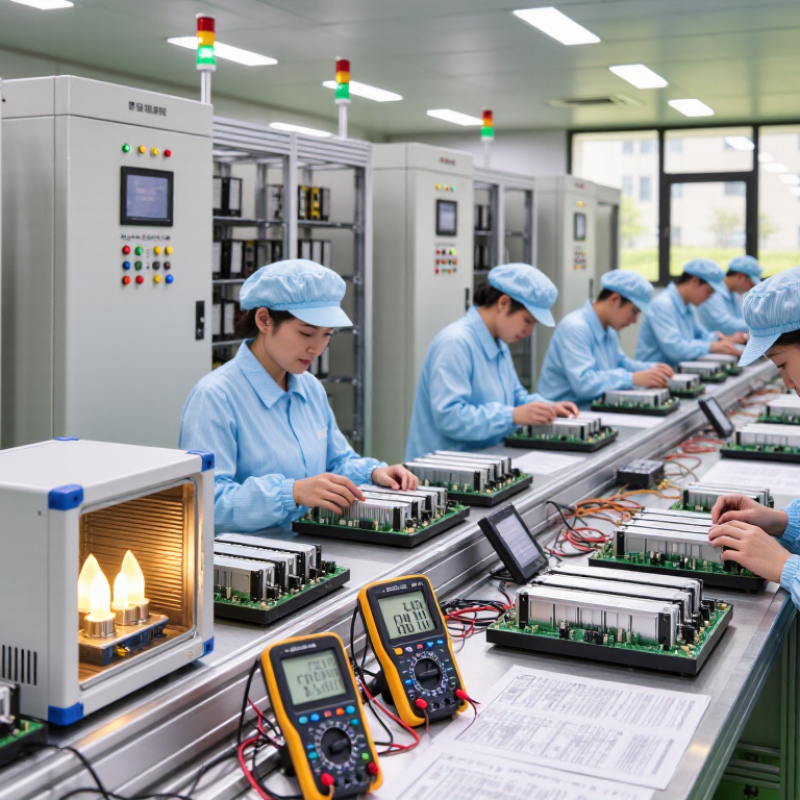
When assessing a Chinese manufacturer, look beyond a headline efficiency number. Ask for performance data across the expected input, load, and temperature ranges. Check whether test reports cover thermal behavior, electrical isolation, and electromagnetic interference. A credible supplier should explain ratings clearly and provide consistent documentation. I would not treat one impressive laboratory result as proof of reliable field performance. Requesting sample units and testing them under realistic operating conditions can reveal details that a brochure misses. Even then, test results need context: wiring, cooling, and load patterns affect performance.
Industry Benchmarks: 96–99% Efficiency and IEC 62477-1 Safety
Choosing a power converter manufacturer in China takes more than comparing headline efficiency. The 96–99% range can be meaningful, but only when test conditions are clear. Ask for efficiency curves across input voltage, load, and temperature. A unit reaching 99% near full load may perform differently at partial load. Numbers need context. Check whether measurements come from a documented test setup, and compare heat rise under realistic operating conditions.
Tips: Request IEC 62477-1 test evidence and confirm which product models and configurations it covers. Review insulation, protective bonding, clearances, and abnormal-operation results. Ask how thermal derating works inside a real enclosure. A concise report is useful, but missing test conditions deserve a follow-up.
Strong manufacturers can explain both performance and limitations without relying on a single impressive figure. Look for traceable quality checks, stable production procedures, and responsive technical support. Request sample data for the intended voltage and load profile, then verify it during acceptance testing. Small differences matter: a warm cabinet, long cable run, or dusty installation can change operating margins. I would not treat one laboratory result as a guarantee; field conditions are messier, and that deserves honest discussion.
Major Chinese Suppliers: Huawei, Sungrow, Sineng, Mornsun, and CRRC
China’s power-converter market spans several distinct specialties. Large suppliers connected to telecom infrastructure often focus on dependable power conversion and monitoring. Renewable-energy manufacturers tend to emphasize grid-scale inverters, system controls, and performance under changing weather. Dedicated converter specialists may offer compact units for industrial equipment, while rail-sector manufacturers design high-power systems for traction and onboard applications. These groups are not interchangeable. A solar project and a railway upgrade need very different engineering support.
For buyers, the useful comparison is not simply rated efficiency. Check the operating voltage range, cooling method, protection features, service coverage, and compatibility with the existing system. Ask for test records and references from projects with similar loads. Small details matter: cabinet clearance, fan noise, replacement lead time, and how alarms appear on a control screen. Easy to miss. Published specifications also rarely reveal how quickly a supplier handles field issues. A shortlist can still mislead if it groups unlike products together. I would compare suppliers by application first, then verify performance claims with project data and a technical review. Even a strong datasheet leaves questions.
Who Are the Best Power Converter Manufacturers in China? — A Comparison of Major Supplier Categories
| Product Segment | Conversion Function | Common Applications | Typical Power Scale | Key Evaluation Factors |
|---|---|---|---|---|
| Photovoltaic inverters | Convert the direct current (DC) produced by solar modules into grid-compatible alternating current (AC). | Residential, commercial, and utility-scale solar power systems. | Ranges from kilowatt-scale units to multi-megawatt systems, depending on design. | Conversion efficiency, grid-code compliance, monitoring, protection features, and service support. |
| Energy-storage power conversion systems (PCS) | Control bidirectional power flow between batteries and an AC grid or local electrical system. | Grid-scale storage, commercial and industrial storage, and microgrids. | Available across a broad range, from smaller installations to multi-megawatt projects. | Battery compatibility, response control, operating modes, protection, and system integration. |
| Industrial AC-DC power supplies | Convert AC input power into regulated DC output for equipment and control systems. | Factory automation, instrumentation, communications equipment, and embedded systems. | Commonly ranges from low-wattage modules to kilowatt-class supplies. | Output stability, isolation, thermal performance, protection functions, and applicable safety approvals. |
| Rail traction converters | Condition and control electrical power for traction motors and related onboard systems. | Electric locomotives, metro systems, and other rail vehicles. | High-power equipment engineered for the requirements of a specific vehicle and traction system. | Reliability, vibration and temperature tolerance, vehicle integration, maintainability, and rail standards. |
| Wind power converters | Regulate electrical output from wind turbines and support controlled connection to the grid. | Onshore and offshore wind energy systems. | Typically designed for turbine-scale power; ratings vary by turbine architecture. | Grid-code performance, environmental durability, turbine compatibility, and long-term serviceability. |
Note: Power scale and selection factors are general product-category characteristics, not specifications for any individual manufacturer or model.
How to Compare Manufacturers by Power Rating, Certifications, and Reliability
A useful comparison starts with the power rating, but the number on a datasheet is only a starting point. Check whether it describes continuous output or a short peak, and under what conditions it was measured. A 500-watt converter may deliver less in a hot, enclosed cabinet. Ask for derating curves at the intended input voltage and temperature. Small details matter. Review startup behavior, overload protection, and ripple under a realistic load, not just at room temperature. A bench test with the actual load can reveal issues that a clean specification sheet misses.
Certifications should match the product’s intended application and destination market. Verify the certificate number, model scope, and issuing body; a certificate for a related product is not enough. Ask for recent production-test records and evidence of component traceability. Reliability needs more than a claimed operating life. Look for burn-in procedures, warranty terms, failure data, and a clear repair process. Ask how the manufacturer handles repeated faults across a production batch. Not always easy to judge. A tidy report can still leave unanswered questions, so request a sample unit and test it through load changes and several hours of operation. A checklist helps, but it cannot replace careful review of the specific model and the conditions in which it will run.
Applications and Selection: Grid, EV, Industrial, and Renewable-Energy Systems
Power converters serve different roles across grid, electric-vehicle, industrial, and renewable-energy systems. For grid-connected equipment, check synchronization behavior, harmonic performance, isolation, and response to voltage changes. A datasheet is only a starting point. Ask how the unit performs under real load transitions, and request test records for the intended operating range.
EV charging systems need stable output across changing battery voltages, plus clear thermal-derating limits. Heat matters. A compact cabinet may look efficient, yet restricted airflow can reduce power on a hot day. Industrial converters face different stresses: motor-start surges, dust, vibration, and long operating hours. Confirm overload capability, enclosure protection, and access to replacement parts. Small omissions can become expensive downtime.
For solar and storage projects, examine MPPT behavior, grid-support functions, and coordination between converters and batteries. These details vary by system; one specification rarely fits every site. When comparing manufacturers in China, review production controls, component traceability, sample-test results, and engineering support after delivery. Ask for evidence, not broad promises. Factory visits and independent testing can help, although they do not replace checking the exact model. I would also leave room for uncertainty: published efficiency figures may not reflect performance at partial load or in a poorly ventilated installation.
Related Posts
-
Who Is the Best Power Converter Manufacturer in China?
-

Understanding the Importance of DC to AC Converters in Modern Power Systems
-
Addressing Common Issues with DC Supply Systems: A Comprehensive Guide
-
What is an AC DC Power Supply and How Does it Work?
-
Best Switching Power Supply Options for Every Application?
-
How to Choose the Right DC Converter for Your Needs?

At Premium PSU, we are specialists in designing and manufacturing power conversion systems for the industrial market. Our product range includes high reliability power supplies from 50W to 72kW.
PREMIUM PSU
C/ Dolors Aleu, 19-21, 2nd Floor
08908 – Hospitalet de Llobregat
Barcelona-SPAIN
t.+34 93 223 26 85