
10 Best Smart Street Lights for Global Buyers?
A Smart Street Light is more than an LED fixture on a pole. It can combine efficient lighting, remote controls, sensors, and monitoring tools. For global buyers, the challenge is matching these features to real street conditions. A coastal road, a busy city junction, and a quiet residential lane do not need identical systems.
Lighting researcher Peter Raynham of University College London has emphasized the importance of designing lighting around people’s visual needs. That is a useful test for any product shortlist. Does the light help pedestrians see a crossing clearly? Can operators adjust dimming without creating dark patches? Are components easy to maintain when a control unit fails? Small details matter. A neat dashboard cannot fix poor light distribution.
This guide compares ten options through practical buyer criteria: roadway performance, control compatibility, energy use, durability, maintenance access, and supplier support. Specifications deserve close reading. A high lumen figure alone does not prove that a road will be evenly lit. Nor does a long warranty guarantee quick replacement parts. Global projects also face different climates, grid conditions, and procurement requirements, so no single model fits every location. That caveat matters.
Some buyers may value advanced sensors; others may prefer a simple, dependable network. The best choice depends on the site, the operating budget, and the skills of the maintenance team. Even a strong shortlist needs field testing. Real streets can be less predictable than product brochures.
What Smart Street Lights Are and How They Work
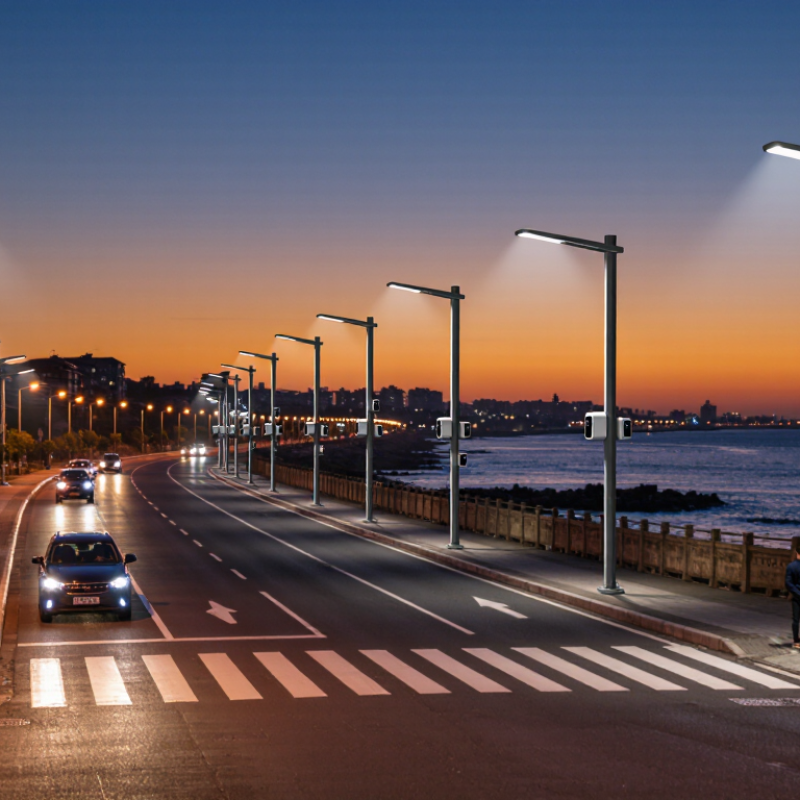
Smart street lights combine efficient luminaires, control devices, and network connections. A typical pole contains an LED light, a controller, and sometimes sensors for motion, ambient light, or faults. The controller can dim the lamp on a schedule or respond to changing conditions. A communications network sends operating data to a central management platform, where staff can check outages and adjust settings remotely. The pole becomes more than a light source.
The U.S. Department of Energy’s 2016 Energy Savings Forecast of Solid-State Lighting projected that LED adoption could reduce U.S. lighting electricity use by about 40% in 2035, compared with a scenario without LED adoption. That estimate covers lighting broadly, not street lights alone. Smart controls may add savings by lowering output when roads are quiet, while keeping illumination responsive to actual conditions. Still, “smart” can overpromise. Network coverage, sensor placement, and maintenance affect real performance. A sensor facing a tree, for example, may react poorly as branches move.
Tips: Check whether a system supports gradual dimming, outage alerts, and manual overrides. Ask how often its data updates, and test controls on a small group of poles before wider deployment. Keep the answer practical. A connected light still needs a clean lens and sound wiring.

Key Technologies Behind Connected Street Lighting
Connected street lighting is more than an efficient lamp; it combines LEDs, sensors, communications, and control software. Street-level units can report outages, dim during quiet hours, and follow scheduled settings. A central management system gives operators a map of faults instead of relying only on night patrols. Networks may use mesh radio or cellular connections, while interoperable interfaces help cities avoid dependence on a single supplier. Small details matter.
The World Bank’s 2016 report, The Economics of LED Lighting, describes energy savings of around 50–70% for LED street-lighting upgrades compared with conventional systems. Actual results vary with existing equipment, operating hours, and dimming plans. Sensors can also misread an empty road when rain, tree movement, or vehicle headlights affect detection. Connectivity adds maintenance needs: devices require secure updates, reliable coverage, and clear ownership of operational data. A technically advanced system can still disappoint if crews cannot diagnose faults quickly.
Tips: Test controls on a small road section before a citywide rollout. Check dimming levels on wet pavement, confirm communications coverage near poles, and ask for measured energy data after installation. Keep manual overrides available; automation is useful, but not infallible.
How Global Buyers Can Evaluate Smart Street Lights
Global buyers should evaluate smart street lights as infrastructure, not as isolated fixtures. Start with the street itself: pole spacing, mounting height, lane width, tree cover, and existing power conditions. A fixture that performs well on an open road may leave dark patches beneath dense branches. Ask suppliers for photometric reports, and check that the tested setup matches the planned installation. Compare light output, dimming range, surge protection, ingress rating, and operating temperature with local site conditions. Numbers matter, but context matters more.
Review the control system as carefully as the lamp. Confirm support for scheduled dimming, fault alerts, and manual overrides during network outages. Ask how data is protected, who can access it, and whether parts can be replaced individually. Clarify warranty terms, spare-part availability, software support, and maintenance intervals. Request a small pilot across different street types, then measure energy use and light levels over several weeks. Test at night. Talk with maintenance crews; their feedback may reveal awkward access, confusing alerts, or slow repairs. A successful month does not prove long-term reliability. Compare lifecycle costs, and record your assumptions before procurement.
10 Best Smart Street Lights for Global Buyers? - How Global Buyers Can Evaluate Smart Street Lights
| Configuration | Typical LED Load | Typical Efficacy | Common Control Options | Key Evaluation Points | Best-Fit Application |
|---|---|---|---|---|---|
| 1. Residential street light | 30–80 W | 120–160 lm/W | Photocell; scheduled dimming; optional wireless node | Check glare control, uniformity, dimming range, and applicable local road-lighting requirements. | Local roads, housing areas, and low-speed streets |
| 2. Urban collector-road light | 80–150 W | 120–165 lm/W | 0–10 V or DALI-2 dimming; networked controls optional | Review photometric files, adaptive dimming schedules, and control-system interoperability. | Collector roads and mixed-use urban streets |
| 3. Arterial-road light | 120–250 W | 130–170 lm/W | DALI-2 or 0–10 V; central management through a compatible controller | Assess roadway-class photometry, thermal performance, surge protection, and maintenance access. | Major urban roads and high-traffic corridors |
| 4. Highway or interchange light | 150–300 W | 130–170 lm/W | Scheduled dimming; wired or wireless control, subject to network design | Confirm pole spacing and mounting height through a lighting design; check wind loading and serviceability. | Highways, ramps, and large road junctions |
| 5. Pedestrian and cycle-path light | 20–60 W | 110–155 lm/W | Time-based dimming; optional motion-responsive control | Prioritize vertical illumination, glare limitation, and carefully commissioned sensor settings. | Footpaths, cycleways, parks, and shared paths |
| 6. Coastal or harsh-environment light | 50–180 W | 120–165 lm/W | Photocell or networked control; standard dimming interface preferred | Verify enclosure rating, corrosion protection, UV resistance, and maintenance requirements for the site. | Coastal roads and locations exposed to dust or severe weather |
| 7. Solar-powered smart light | 20–100 W LED load | 110–160 lm/W | Charge controller; programmable dimming; optional remote monitoring | Size the panel and battery for local solar conditions, autonomy needs, temperature, and battery life. | Remote roads and sites where grid connection is costly or unavailable |
| 8. Connected light with a 7-pin socket | 40–200 W | 120–170 lm/W | ANSI C136.41-style receptacle with a compatible control node; verify dimming interface | Confirm socket wiring, node compatibility, cybersecurity provisions, and ownership of network data. | Projects using a compatible 7-pin control ecosystem |
| 9. Connected light with a Zhaga interface | 30–180 W | 120–170 lm/W | Zhaga-D4i-compatible interface and certified compatible control devices | Check interface certification, device profile, sensor functionality, and platform integration before purchase. | Modular smart-lighting projects seeking replaceable control nodes |
| 10. Smart-ready light with basic photocell control | 30–250 W | 120–165 lm/W | Photocell; optional dimming driver or control receptacle for future upgrades | Compare initial cost with future upgrade options, driver compatibility, and replacement-part availability. | Phased rollouts and budgets that require a gradual move to connected controls |
Before procurement, request independently verifiable photometric reports, applicable safety and EMC documentation, warranty terms, spare-parts availability, and a lighting design for the actual road geometry. Control interfaces and communication networks are not automatically interoperable.
Ten Smart Street Light Options for Different Needs
Ten smart street light options serve different roads, climates, and budgets. An adaptive LED suits streets needing scheduled dimming; a solar-hybrid unit helps where trenching is costly. Grid-connected photocell models simplify dusk-to-dawn operation. High-output dimmable fixtures suit busy arterials, while pedestrian sensors can lower output on quiet residential blocks. Small streets differ.
At crossings, radar-enabled lights can respond to movement without relying on fixed schedules. Wireless mesh controls suit dense districts with many poles; cellular controls can simplify oversight across scattered sites. Coastal roads need corrosion-resistant housings, and modular poles can accommodate add-on sensors. These features should match local maintenance skills, not just a procurement checklist. DOE’s 2016 report on U.S. LED street-light adoption describes municipal projects achieving substantial energy reductions, often around 50% or more against older lighting. Results vary with the baseline and operating plan.
The IEA’s Energy Efficiency 2023 report says LEDs can use up to 80% less electricity than incandescent lamps; that comparison is not a street-project guarantee. Ask suppliers for measured wattage, dimming schedules, ingress protection, and component replacement details. Test a small area first. One easy-to-miss issue: dimming may reduce visibility if settings ignore weather, road geometry, or pedestrian activity. I would compare actual night readings before expanding deployment.
Regional Standards, Installation, and Maintenance Factors
Regional standards can change a smart street light’s performance as much as its optics. IEC 60598-2-3 covers luminaires for road and street lighting, while regional projects may also require local electrical, photometric, and safety rules. In North America, buyers may encounter ANSI/NEMA C136.41 control interfaces. Confirm the required interface before ordering; a compatible socket does not guarantee compatible software.
The IEA reports that lighting uses about 15% of global electricity and produces roughly 5% of global greenhouse gas emissions. These figures cover lighting broadly, not street lights alone, but they show why efficiency claims deserve scrutiny. Ask suppliers for test conditions, dimming schedules, and measured system power—not just a headline savings percentage. Numbers need context.
Installation conditions matter. A coastal pole may face salt spray; an inland site may endure dust, heat, or freezing nights. Check ingress protection, surge protection, mounting dimensions, and access for maintenance. A crew should be able to replace a driver without removing the whole luminaire. Also confirm who owns network credentials and fault logs. I would not assume wireless control will work reliably on every street; nearby buildings and tree cover can weaken signals. Pilot a small area, then compare actual energy use and outage records with the baseline before expanding.
Article Source:
At Premium PSU, we are specialists in designing and manufacturing power conversion systems for the industrial market. Our product range includes high reliability power supplies from 50W to 72kW.
PREMIUM PSU
C/ Dolors Aleu, 19-21, 2nd Floor
08908 – Hospitalet de Llobregat
Barcelona-SPAIN
t.+34 93 223 26 85