
China Best Graphite Clay Crucible Supplier?
Choosing the China Best Graphite Clay Crucible Supplier? The answer requires more than comparing prices or polished product photos. A dependable Graphite Clay Crucible must survive repeated heating, metal contact, lifting, and sudden cooling. In practical foundry work, small cracks often appear after several cycles, not during the first test.
Industry demand also makes supplier verification more important. The U.S. Geological Survey’s Mineral Commodity Summaries 2025 estimates global natural graphite mine production reached approximately 1.6 million metric tons in 2024. The International Energy Agency’s Global Critical Minerals Outlook 2024 also identifies graphite as an important mineral for clean-energy supply chains. These reports describe raw-material pressure, not crucible quality directly. Still, they explain why consistent graphite sourcing deserves careful attention.
A credible Chinese supplier should provide measurable data for graphite purity, clay composition, bulk density, apparent porosity, thermal-shock resistance, and maximum working temperature. Test reports should identify methods, sample conditions, and production batches. ISO 9001 certification can support process control, but it cannot replace independent performance testing. Ask for trial samples and inspect the inner surface after heating. Look for swelling, flaking, pinholes, and metal penetration.
No supplier is perfect. That matters. A strong evaluation should compare factory experience, mold accuracy, packing protection, export records, and technical communication. Some suppliers publish impressive specifications but offer weak after-sales support. Others provide modest documents and better real-world results. This guide examines the evidence, with a practical focus on durability, consistency, application fit, and total purchasing risk.
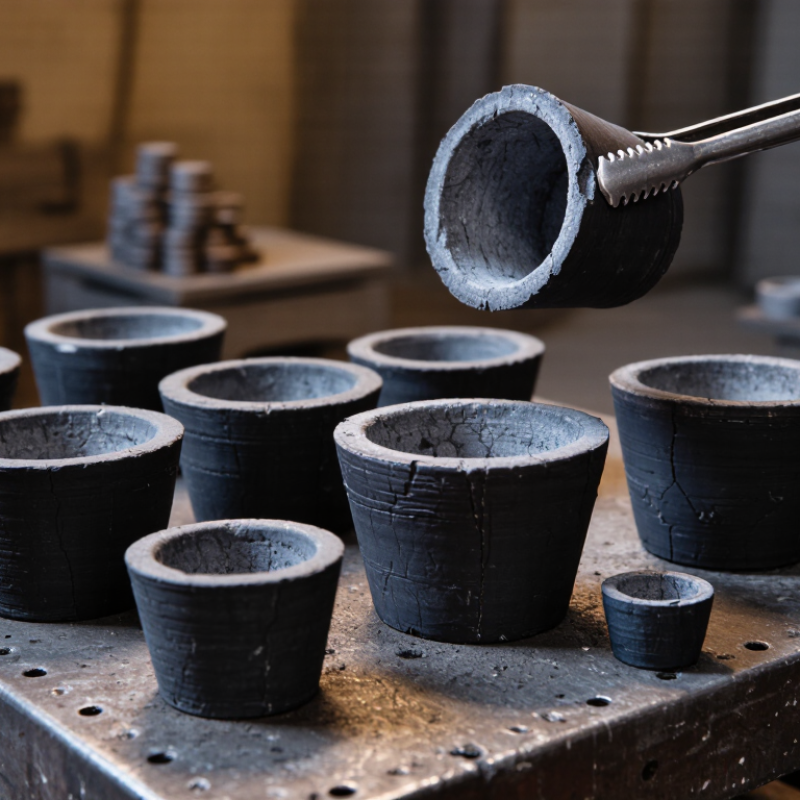
What Is a Graphite Clay Crucible and Where Is It Used?
A graphite clay crucible is a heat-resistant vessel made from natural graphite and refractory clay. Graphite spreads heat quickly and reduces thermal shock. Clay improves shape retention during repeated heating. Some grades also contain silicon carbide for stronger oxidation resistance. The exact formula matters more than appearance.
These crucibles commonly melt aluminum, copper, brass, zinc, and selected precious-metal alloys. Foundries use them in gas-fired furnaces, electric furnaces, and small induction units. A 10-kilogram crucible may hold a bright pool of aluminum within minutes, but heating speed depends on furnace design. They are also used in casting workshops, laboratories, recycling operations, and technical education.
The USGS Mineral Commodity Summaries 2024 reported about 1.6 million metric tons of natural graphite mine production worldwide in 2023. This large supply supports many refractory applications, but it does not guarantee consistent crucible quality. The IEA’s Global Critical Minerals Outlook 2024 also highlighted graphite’s growing importance in industrial and energy technologies. Buyers should request density, wall-thickness tolerance, maximum operating temperature, and thermal-cycle test results. Supplier claims alone are insufficient. One practical weakness remains: graphite clay crucibles oxidize in air, especially when overheated or stored poorly. Preheating, dry storage, and correct flux selection can extend service life. Some operators still treat these steps as optional. That is a costly mistake.

How to Evaluate Graphite Clay Crucible Quality and Performance
China Best Graphite Clay Crucible Supplier?
How to Evaluate Graphite Clay Crucible Quality and Performance
Choosing a graphite clay crucible requires more than comparing prices. In practical foundry work, material consistency often determines service life. Inspect the crucible surface under bright light. It should appear dense, even, and free from deep cracks, soft spots, or loose particles. Small marks may be harmless, but open pores can absorb molten metal and weaken the wall.
Check the stated graphite content, clay composition, maximum working temperature, and recommended heating rate. Reliable suppliers should provide test data, dimensional tolerances, and batch inspection records. Ask how the crucible handles repeated heating and cooling. A good crucible should resist thermal shock without severe swelling or edge damage. Its wall thickness should remain consistent, especially near the base and pouring lip.
Performance testing is more useful than impressive certificates alone. Weigh a sample, measure its dimensions, and compare both values across several pieces. Heat it gradually in a controlled furnace, then inspect the surface after cooling. I have seen crucibles that performed well once but deteriorated after several cycles. That result is easy to overlook. No test is perfect. Humidity, furnace design, fuel quality, and operator habits also affect service life. A trustworthy supplier discusses these limits honestly instead of promising unrealistic durability. Performance records from similar applications offer stronger evidence than general advertising claims.
Why Choose a Chinese Graphite Clay Crucible Supplier?
Choosing a Chinese graphite clay crucible supplier can reduce sourcing friction when technical control is visible. The USGS Mineral Commodity Summaries 2025 estimates China produced about 1.3 million metric tons of natural graphite in 2024. This large raw-material base supports established processing, forming, and firing networks. However, graphite availability does not automatically prove crucible quality. That assumption needs testing.
Experienced buyers should request batch-level data, not attractive catalog language. Check apparent porosity, bulk density, thermal-shock performance, wall thickness, and chemical compatibility. A supplier should explain its clay-to-graphite ratio and firing temperature clearly. Trial crucibles should survive repeated heating, cooling, charging, and pouring cycles. Inspectors can also compare dimensional tolerance after firing. Small variations often become costly during automated loading.
China also has strong downstream graphite-processing capacity. The International Energy Agency’s Global Critical Minerals Outlook 2024 reports that China performs more than 90% of global graphite refining. This does not measure crucible output directly, but it indicates deep processing expertise and supplier access. Many factories can adapt dimensions, pouring lips, and packaging for different furnaces. Lead times may also improve through domestic material coordination. Still, the lowest quotation can hide weaker consistency. A practical audit should review production records, sample results, export packaging, and corrective-action history before approval.
China Best Graphite Clay Crucible Supplier? Why Choose a Chinese Supplier?
China has a large graphite supply base, which can support material availability, production continuity, and cost-efficient sourcing for graphite clay crucibles. The chart below shows estimated natural graphite mine production by major producing country in 2023, measured in thousand metric tons.
Production scale is only one supplier-selection factor. Buyers should also evaluate crucible density, thermal-shock resistance, maximum recommended operating temperature, dimensional consistency, testing documentation, packaging, and export experience. Data source: U.S. Geological Survey, Mineral Commodity Summaries 2024, Graphite—Natural, 2023 estimated mine production.
What Manufacturing Standards Should Chinese Suppliers Meet?
China’s graphite clay crucible suppliers should meet documented manufacturing standards, not only offer attractive prices. The USGS Mineral Commodity Summaries 2025 reported China produced about 1.27 million metric tons of natural graphite in 2024. That scale creates capacity, but not automatic quality.
A reliable supplier should operate under ISO 9001 quality controls. Each batch needs raw-material records, forming parameters, firing temperatures, and inspection results. Crucible dimensions should be checked with calibrated tools. Density, apparent porosity, ash content, and thermal expansion also require recorded testing. ASTM C20 methods can support porosity and density evaluation for refractory products, although crucibles may need application-specific procedures. Test conditions must be stated clearly.
THERMAL SHOCK Thermal shock matters most in daily furnace use. A qualified supplier should provide repeated heating and cooling results, not one impressive sample. Look for certificates of analysis, lot numbers, sample retention, and traceability from clay and graphite inputs. ISO 14001-based environmental controls are also useful for monitoring dust, wastewater, and kiln emissions. Documentation helps.
Still, paperwork can mislead.
A supplier may pass an audit yet produce uneven crucibles. I would request independent testing before a large order, especially for wall thickness, cracking, and metal contamination. The IEA’s Global Critical Minerals Outlook 2024 identifies graphite as a fast-growing material for clean-energy supply chains, increasing pressure on production capacity. Faster production can weaken inspection discipline. Chinese suppliers should therefore combine ISO-based systems with furnace-level records, operator training, and practical thermal-cycle testing.
How to Select the Best Graphite Clay Crucible Supplier in China?
China Best Graphite Clay Crucible Supplier?
How to Select the Best Graphite Clay Crucible Supplier in China?
Selecting a Chinese supplier requires more than comparing prices. The USGS Mineral Commodity Summaries 2024 reported about 1.6 million tonnes of global natural graphite production in 2023. This scale supports broad raw-material access, but quality can still vary between factories. Ask for the graphite grade, clay composition, bulk density, apparent porosity, and maximum working temperature. These figures should appear on a technical datasheet, not only in sales messages.
Request test records for thermal shock, oxidation resistance, and dimensional stability. A reliable supplier should explain firing temperatures, inspection frequency, and acceptable tolerances. Check whether each batch receives a traceable production code. For furnace use, request samples matching your metal, heating cycle, and atmosphere. Small samples reveal cracking, slag adhesion, and wall erosion better than attractive photographs.
Look closely at packaging. Thick moisture barriers and impact protection matter during long-distance transport. Supplier audits should include raw-material storage, kiln control, machining accuracy, and final inspection. The International Energy Agency’s Global Critical Minerals Outlook 2024 highlights rising pressure on mineral supply chains, making traceability increasingly practical rather than optional. One detail is often missed: a crucible rated for a high temperature may fail under repeated thermal cycling. I would not accept a certificate without checking its test method, date, and laboratory identity. Mistakes happen. A controlled trial remains essential.
Article Source:
At Premium PSU, we are specialists in designing and manufacturing power conversion systems for the industrial market. Our product range includes high reliability power supplies from 50W to 72kW.
PREMIUM PSU
C/ Dolors Aleu, 19-21, 2nd Floor
08908 – Hospitalet de Llobregat
Barcelona-SPAIN
t.+34 93 223 26 85