How to Choose a Commercial Food Sealer Machine?
Choosing a Commercial Food Sealer Machine is less about buying the largest model and more about matching the equipment to your products and daily workflow. A small bakery sealing pouches of roasted nuts has different needs from a meal-prep kitchen packing chilled portions. Bag material, product moisture, package size, and hourly output all affect the right choice. So does the space beside your worktable.
For this guide, fictional packaging specialist Dana Brooks offers a practical rule: “Choose the sealer for the package you make most—not the one you imagine making someday.” It is a useful reminder, though real production plans can change. A machine that handles today’s bags may feel limiting after a new product launch.
Compare sealing methods, including impulse and continuous heat sealing, against your actual packaging materials. Check the maximum seal width and cycle rate, then ask how long the machine needs to cool between runs. Look closely at the controls. Can staff set temperature and sealing time without guesswork? Are contact surfaces easy to clean? A few crumbs or traces of oil can affect a seal.
Before buying, test representative bags with real products. Inspect the finished seals and check whether packages open cleanly without tearing. Ask about replacement parts, service access, and routine maintenance. A fast machine is not automatically a good fit. Sometimes the less impressive model is easier to operate, clean, and keep running.
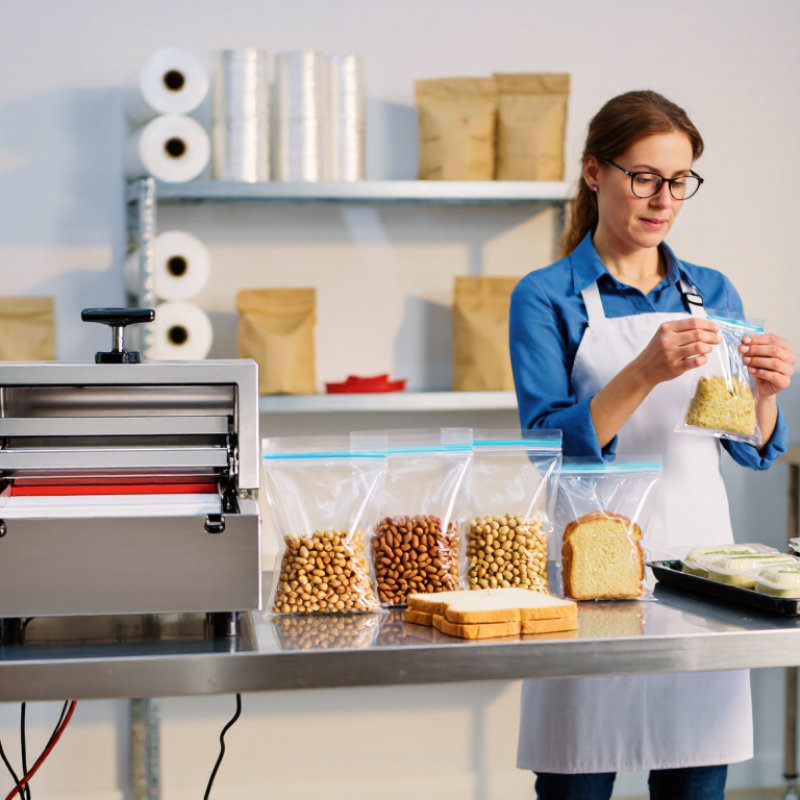
Identify Your Packaging Needs and Daily Sealing Volume
How to Choose a Commercial Food Sealer Machine?
Before comparing machines, define what each package must protect and how it moves through your workflow. Are you sealing dry grains, powdered ingredients, or moist portions? Product texture affects the seal width, bag material, and vacuum level you may need. A delicate pastry can crush under strong suction, while moisture on a bag edge can weaken the seal. Test representative products, not just empty bags. Small detail, big difference.
Estimate your daily volume from production records, then account for peak periods and changeovers. If staff seal 180 pouches across a six-hour shift, a machine’s advertised cycle rate may not reflect actual output. Loading, inspection, and breaks take time. Measure it. Count package sizes, too. Frequent changes between pouch widths can slow work more than expected. A tabletop unit may suit short runs, while continuous production may need a conveyor or chamber system. Ask for a trial with your own filled packages, and record cycle time, seal consistency, and rejected bags. Keep room for growth, but avoid buying capacity your team cannot use. On paper, an estimate can look tidy, then fall short on a busy Monday. That deserves a second look.
How to Choose a Commercial Food Sealer Machine? — Identify Your Packaging Needs and Daily Sealing Volume
Match the sealer to your package format, product, and expected daily output. Volume ranges below are practical planning estimates; actual throughput depends on bag size, operator speed, loading time, and product handling.
| Packaging need | Typical daily volume | Sealer type to consider | Why it may fit | Check before buying |
| Small batches of dry foods, baked goods, or ingredients in heat-sealable pouches | Up to about 100 bags | Impulse heat sealer | A simple, operator-controlled option for intermittent sealing and short production runs. | Confirm that the pouch material is heat-sealable and that the sealing bar accommodates its width and thickness. |
| Frequent sealing of dry or powdered foods in premade bags | About 100–500 bags | Continuous band sealer | Feeds bags through heated sealing belts, reducing repeated manual clamping. | Check bag thickness, seal direction, conveyor speed, and whether the machine suits the bag material. |
| Meat, cheese, or other products requiring air removal in vacuum pouches | About 50–300 pouches | Single-chamber vacuum sealer | Removes air from bags placed inside the chamber and seals them in a controlled cycle. | Check chamber size, seal-bar length, pump capacity, and pouch compatibility. Liquids and wet products need suitable handling. |
| Higher-volume vacuum packing with minimal interruption between loads | About 300–1,000 pouches | Double-chamber vacuum sealer | One chamber can be loaded while the other runs a cycle, supporting a steadier workflow. | Compare chamber dimensions, electrical requirements, operator space, and the cycle time with your actual product. |
| Prepared meals, deli foods, or produce in trays with a lidding film | About 100–800 trays | Manual or semi-automatic tray sealer | Designed to seal a film lid to a compatible tray; some models can also use modified-atmosphere packaging. | Verify tray dimensions, film type, tooling requirements, and whether gas flushing is needed for the product. |
| Long production runs of compatible pouches or trays | More than about 1,000 packages | Automatic in-line sealer or automated tray sealer | Can integrate with a production line to reduce repetitive manual handling at sustained volumes. | Request a product-and-package trial; assess line speed, changeover time, guarding, cleaning, and service access. |
Selection tip: Test the sealer with your actual product and packaging before purchase. Confirm seal integrity, package dimensions, cleaning needs, power supply, and any food-safety requirements for your operation.
Compare Commercial Food Sealer Types and Their Operating Methods
Commercial food sealers differ by how they handle air, heat, and packaging. FAO’s 2019 State of Food and Agriculture estimated that 14% of food is lost between harvest and retail. That figure does not promise a sealer will prevent waste, but it highlights the value of sound package integrity. Match the machine to the product and package—not just the target speed.
Impulse sealers heat only while the jaws are closed, making them practical for intermittent bag sealing. They suit many heat-sealable films, but operators must allow cooling between cycles. Constant-heat sealers keep their bars hot, helping with thicker or laminated materials. Simple, but limiting: temperature and dwell time need careful control to avoid weak or scorched seams.
Vacuum chamber machines remove air inside a chamber before sealing; they work well with liquid-rich foods because the product stays contained. External vacuum sealers draw air through a nozzle, often making them easier to fit into smaller work areas. Continuous band sealers move filled bags along heated belts, while tray sealers apply film to prepared trays. Check the seal. A chamber machine may be slower for small batches, and a band sealer may need adjustment when bag thickness changes. Run sample packs with the actual product and film, then inspect seams after cooling.
Check Bag Compatibility, Seal Width, and Product Requirements
A commercial food sealer should match the bags you use every day. Check whether the machine supports your bag material, thickness, width, and opening style. Some sealers handle flexible pouches but struggle with thicker, textured, or laminated bags. A sample test can reveal weak spots before you commit. Test bags from your actual supplier, since small material changes may affect sealing.
Seal width matters, but wider is not automatically better. Choose a width that creates a continuous seal across the bag opening without wasting material. Consider what the product leaves behind: oil, crumbs, or moisture near the edge can cause leaks. Product shape matters too. Sharp frozen pieces may puncture a bag, while vacuum pressure can crush delicate foods. For warm or moisture-sensitive products, check the machine’s temperature and timing controls. Record settings and inspect seals during a normal production run; a quick showroom test may not reflect real use.
Tips: Seal several filled bags, then check each seam for gaps or peeling. Test the thickest bag and the messiest product you expect to package. Don’t assume one setting works for every product.
Evaluate Throughput, Controls, Safety, and Maintenance
Choosing a commercial food sealer means matching its real output to your busiest shift, not its advertised maximum. Count packages per minute, then test the machine with your actual pouch material, fill weight, and sealing temperature. A queue of warm, uneven bags can expose a throughput gap quickly. Leave room for changeovers, too.
Controls should make adjustments clear and repeatable. Check whether operators can set temperature, dwell time, and pressure without navigating confusing menus. Ask for documented settings and training. PMMI’s 2023 State of the Industry reporting highlights workforce and automation challenges across packaging operations; simpler controls can reduce reliance on hard-to-find specialist support. Small details matter.
Safety and maintenance deserve a hands-on check. Inspect guards, emergency stops, hot surfaces, and access for cleaning before purchase. The U.S. Bureau of Labor Statistics reported 2.6 million nonfatal workplace injuries and illnesses in private industry in 2023; that figure is not specific to sealers, but it underlines why safe access matters. Request a maintenance schedule, spare-parts list, and expected service intervals. Test it cold. Then inspect the seal after a full production run. I would not trust a perfect sample alone; inconsistent film tension can still cause weak seals on a busy line.
Compare Total Ownership Costs and Supplier Support
A commercial food sealer’s purchase price is only the starting point. Compare five-year costs for film waste, energy, planned maintenance, spare parts, training, and downtime. Ask suppliers to price routine service and common replacement parts in writing. A low-cost unit can become expensive when a heater strip or control component takes days to arrive. Small delays add up.
Supplier support deserves the same scrutiny as machine specifications. Request a written response-time commitment, local technician coverage, and a clear warranty process. Ask who will train operators to adjust sealing temperature and pressure for your actual packaging materials.
The U.S. Department of Energy’s Operations & Maintenance Best Practices Guide reports predictive maintenance costs 8–12% less than preventive maintenance, across general industrial settings. McKinsey’s manufacturing analysis reports predictive maintenance can reduce equipment downtime by 30–50%.
These are broad benchmarks, not guarantees for a food sealer. Still, they show why service access and maintenance planning belong in the cost comparison. Ask for proof. A service promise without parts availability is thin comfort; I’ve seen that assumption look tidy on paper and fail on a busy shift.