
China Top 10 Door Entry Systems Suppliers?
China has become a major source of access-control technology, serving apartments, offices, factories, hotels, and public facilities worldwide. This article explores China’s top 10 Door Entry Systems suppliers and the practical strengths behind their market positions. The list considers product quality, manufacturing experience, technical support, certifications, customization, and export reliability. It also examines how suppliers handle real installation conditions, from a narrow apartment lobby to a busy industrial gate.
Details matter here. A reliable supplier should offer clear wiring diagrams, durable outdoor panels, responsive software, and stable replacement-part availability. Video intercoms, RFID readers, keypad access, mobile credentials, and visitor management tools may appear similar, yet their performance can differ greatly. A camera may produce sharp images in daylight but struggle under weak corridor lighting. A door controller may work smoothly during testing but require better network protection in daily use.
Not every supplier fits every project. Price is important, but it should not replace lifecycle evaluation. Buyers should verify factory capabilities, product testing procedures, installation guidance, warranty terms, and after-sales response times. Independent certifications and documented case experience can improve confidence, although marketing claims still deserve careful review. This comparison may not answer every regional requirement. That is worth admitting. Local building codes, climate conditions, data-protection expectations, and integrator skills can change the final decision.
The selected companies represent different approaches, including large-scale manufacturing, specialized hardware, smart security platforms, and project-based integration. By comparing them through practical evidence, readers can identify suitable partners instead of choosing by catalog appearance alone. Capability matters. So does accountability.
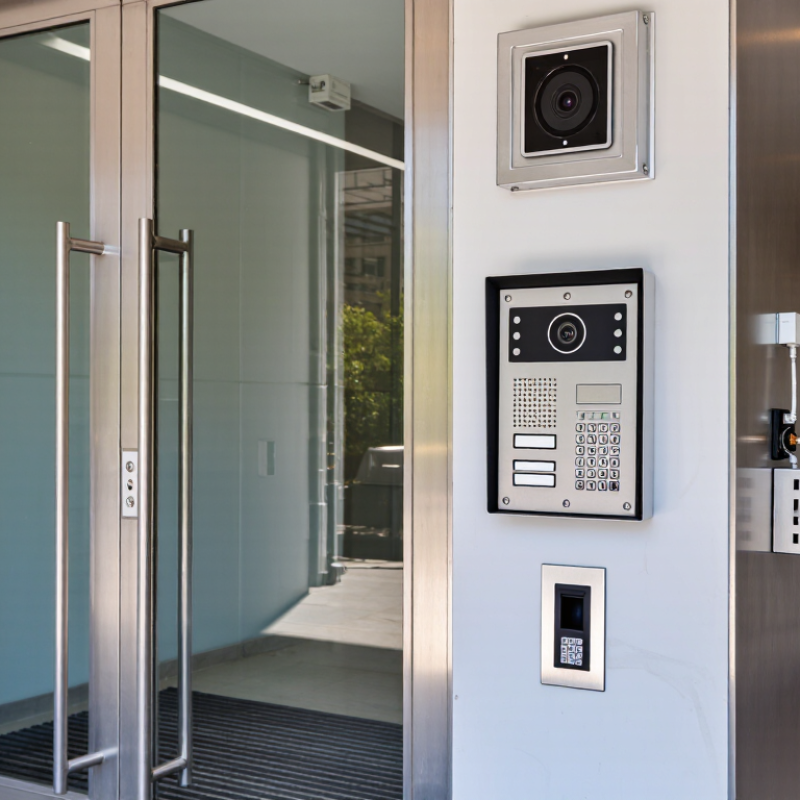
How China’s Door Entry Systems Supplier Market Is Structured
China’s door entry systems supplier market is structured around several connected layers. Manufacturers produce readers, controllers, indoor monitors, locks, and management software. Some factories focus on high-volume standard products, while others provide OEM or ODM development for overseas buyers. Regional distributors then connect these products with installers, contractors, and property developers.
In practical projects, supplier capability differs sharply. A factory may offer strong hardware but limited software integration. Another may provide flexible customization but slower technical support. Apartment buildings often require centralized management, visitor records, and emergency communication. Offices may prioritize access permissions, audit logs, and easy employee enrollment. Export buyers should check testing reports, firmware update policies, spare-part availability, and response times before signing. A polished sample does not prove stable performance. That mistake is common.
Tips:
Request a live demonstration with several doors and users. Ask for written performance limits, not only sales promises. Confirm whether the quoted price includes software licenses, mounting parts, cloud fees, and training. Review a sample support ticket if possible. It reveals communication quality. Also inspect packaging, wiring labels, and installation manuals. Small details reduce field errors.
No supplier fits every project. Buyers should compare total ownership costs, not just the initial quotation. Some assumptions may still need testing, especially when products must connect with existing security platforms or local building systems.

Criteria for Ranking the Top 10 Chinese Door Entry Systems Suppliers
Ranking Chinese door entry system suppliers requires more than comparing catalog prices. I would begin with verifiable manufacturing experience, documented quality controls, and project evidence from similar building types. A polished website proves little. Factory audits, production records, and traceable component sourcing provide stronger evidence. Suppliers should explain how they test outdoor panels, indoor monitors, locks, power supplies, and network connections before shipment. These details reveal practical competence.
The ranking should give measurable weight to certification, safety testing, and destination-market compliance. Product compatibility matters too. A system must connect reliably with existing elevators, cameras, fire controls, and property software. During evaluation, sample units should face repeated calls, power interruptions, moisture exposure, and poor network conditions. Test results should be recorded, not described vaguely. Technical support deserves a separate score, including response time, manuals, remote diagnostics, spare-part availability, and installer training. Fast replies are useful. Clear replies matter more.
Commercial reliability also includes lead-time accuracy, warranty terms, packaging quality, and support for older models. I would review independent customer references and inspect failure data when available. Some suppliers may score highly on innovation but poorly on documentation; that weakness should remain visible. Pricing can influence the result, but the lowest quotation should never dominate it. A transparent model may assess quality at 30 percent, technical performance at 25 percent, service at 20 percent, compliance at 15 percent, and value at 10 percent. These percentages are not perfect. They should change when project risks change.
Profiles of the Top 10 Door Entry Systems Suppliers in China
China’s leading door entry systems suppliers serve apartments, offices, hotels, and industrial sites. The profiles below focus on manufacturing depth, product reliability, and installation support.
Supplier One develops video intercom panels with sharp night imaging. Supplier Two focuses on biometric access terminals for controlled buildings. Supplier Three produces compact audio door phones for residential projects. Supplier Four combines smart locks with mobile credentials and visitor records. Supplier Five supplies weather-resistant outdoor stations for humid regions. Supplier Six serves large developments with centralized management software. Supplier Seven specializes in elevator-linked access control. Supplier Eight offers stainless steel panels for hospitals and public facilities. Supplier Nine builds customized systems for contractors and property managers. Supplier Ten supports budget-conscious projects with modular products and replaceable parts.
Details matter. Look for tested ingress protection, stable wiring, and clear maintenance records. Some suppliers operate automated assembly lines, while others rely more heavily on manual inspection. That difference can affect consistency. Certifications should be checked against the destination market, not copied from a sales brochure. After-sales response also deserves attention. A replacement reader may be useless if technical support answers slowly. Factory audits, sample testing, and reference projects provide stronger evidence than attractive catalogs. Still, no supplier is perfect. Software updates may be uneven, and installation quality can change the final experience. Procurement teams should request wiring diagrams, warranty terms, spare-part policies, and realistic delivery schedules before placing large orders.
Comparison of Products, Technologies, and Service Capabilities
China Top 10 Door Entry Systems Suppliers
Comparing China’s top ten door entry system suppliers requires more than checking product prices. A practical review should examine controllers, card readers, smart locks, video intercoms, and management software. Some suppliers offer complete systems, while others focus on one reliable device. That difference matters during installation and maintenance.
Technology varies widely. RFID remains simple and affordable for offices, while mobile credentials improve convenience. Facial recognition can reduce contact, but privacy rules and user consent require careful attention. Cloud platforms support remote management, yet unstable networks may interrupt access. Look for encrypted communication, role-based permissions, audit logs, and open API support. Security should be tested, not merely advertised.
Service capability often separates a strong supplier from an average one. Evaluate installation guidance, spare-part availability, firmware updates, response times, and warranty terms. Local technical support can shorten downtime when a reader fails at a busy entrance. Certifications and documented testing also provide useful evidence. However, no ranking is perfect. A supplier may provide excellent hardware but weak software integration. Another may respond quickly but lack long-term parts support. Request a live demonstration, inspect sample documentation, and test the system under poor network conditions. Small details matter.
How to Select the Right Chinese Door Entry Systems Supplier
Selecting a Chinese door entry systems supplier requires more than comparing catalog prices. A 2024 Fortune Business Insights report valued the global access control market at about USD 10.4 billion in 2023, with continued growth expected through 2032. This expansion attracts capable manufacturers, but also creates uneven quality. Request factory audit records, test reports, production photos, and recent export references. A polished website proves little.
Check the complete system, not only the indoor monitor. Confirm camera resolution, night visibility, relay protection, network standards, mobile access, and emergency power behavior. Ask for a live video demonstration with a weak network connection. It reveals delays quickly. Also examine enclosure materials, button durability, and cable terminals. These small details matter in humid apartment entrances. ISO 9001 certification can support process control, but it does not replace product testing or field evidence.
The supplier should explain firmware updates, spare-part availability, warranty response time, and integration with existing locks or elevators. MarketsandMarkets has identified rising demand for connected access control, making software support increasingly important. Obtain written delivery terms and a sample before placing a larger order. My practical mistake was trusting a low quotation before calculating installation labor and replacement stock. Cheap hardware became expensive after deployment. Ask who owns the configuration files. Confirm response times in writing.
| No. | Selection Dimension | What to Verify | Recommended Buyer Benchmark | Required Evidence | Why It Matters |
|---|---|---|---|---|---|
| 1 | Product Portfolio | Availability of audio intercoms, video door phones, apartment systems, villa systems, access-control terminals, indoor monitors and management software. | At least 3 compatible system configurations for the intended project type. | Current product catalogue, technical datasheets and system architecture diagrams. | A broader portfolio reduces integration risks and makes future expansion easier. |
| 2 | Communication Protocols | Support for SIP-based communication, TCP/IP networking, RTSP video streaming or other open interfaces where required. | Open protocols documented in writing; avoid systems that depend entirely on undocumented interfaces. | Protocol manuals, API documentation and a live interoperability test. | Open interfaces improve compatibility with PBX, building-management and security platforms. |
| 3 | Network and Power Design | Ethernet connectivity, Power over Ethernet compatibility, local power input, network topology and backup-power options. | Confirm compatibility with IEEE 802.3af or IEEE 802.3at when PoE is specified for the project. | Power budget, wiring diagram, PoE declaration and installation instructions. | Correct power planning helps prevent voltage drops, random reboots and costly rewiring. |
| 4 | Outdoor Protection | Ingress protection, operating temperature, impact resistance, drainage design and suitability for exposed entrances. | Use an enclosure rating appropriate to the site; IP65 is a common target for exposed equipment, subject to installation conditions. | Test reports, enclosure rating documentation and environmental specifications. | Outdoor door stations face rain, dust, temperature changes and repeated physical use. |
| 5 | Access Methods | Support for PIN codes, RFID credentials, mobile access, QR codes, biometric options and exit buttons. | At least two independent access methods plus a mechanical or electrical emergency-release procedure. | Credential compatibility list, security settings and emergency-operation procedure. | Multiple access methods improve convenience and provide operational redundancy. |
| 6 | Security and Data Protection | Administrator roles, encrypted communication, password policy, audit logs, firmware controls and data-retention settings. | Individual administrator accounts, role-based permissions, encrypted remote access and exportable event logs. | Cybersecurity statement, privacy documentation, update policy and sample audit log. | Door-entry systems process access events and may handle personal or video data. |
| 7 | Standards and Market Compliance | Applicable electrical, electromagnetic-compatibility, radio, safety and environmental requirements for the destination market. | Documentation must match the final model, hardware revision and destination country; do not rely only on a general certificate. | Declarations of conformity, test reports, labels and applicable regional approvals. | Correct compliance documentation supports customs clearance, installation approval and buyer acceptance. |
| 8 | Customization Capability | Logo or interface customization, language packs, relay configuration, enclosure changes, firmware settings and API integration. | Written confirmation of what is standard, configurable, chargeable or subject to a minimum order quantity. | Customization checklist, engineering-change process and approved sample. | Clear customization rules reduce misunderstandings about appearance, function and delivery time. |
| 9 | Quality Control and Testing | Incoming inspection, assembly inspection, functional testing, network testing, burn-in testing and traceability. | Require documented inspection criteria and a pre-shipment inspection plan for every production batch. | Quality manual, inspection records, test checklist and sample serial-number traceability. | Structured testing is more reliable than evaluating quality only from a product sample. |
| 10 | After-Sales and Supply Continuity | Warranty terms, spare parts, firmware support, remote troubleshooting, replacement policy and product-lifecycle planning. | Obtain written warranty coverage, response times, spare-parts availability and an end-of-life notification process. | Warranty document, service-level terms, support contacts and product-lifecycle statement. | Long-term support is essential because installed door-entry equipment can remain in service for years. |
Note: The benchmarks above are buyer-side evaluation targets based on commonly used industry practices and published technical standards. Confirm the final requirements against the project location, building regulations and destination-market compliance rules.
Article Source:
At Premium PSU, we are specialists in designing and manufacturing power conversion systems for the industrial market. Our product range includes high reliability power supplies from 50W to 72kW.
PREMIUM PSU
C/ Dolors Aleu, 19-21, 2nd Floor
08908 – Hospitalet de Llobregat
Barcelona-SPAIN
t.+34 93 223 26 85