
What Are the Top Robotic Gear Types in 2026?
Choosing the right Robotic Gear in 2026 means balancing torque, speed, precision, size, and service life. A compact robot wrist may need low backlash and smooth motion, while a mobile platform may prioritize shock resistance and efficient power transfer. One gear type rarely meets every need. Small details matter.
This guide introduces the main options: spur, helical, planetary, bevel, worm, harmonic, and cycloidal gears. Each has distinct strengths and trade-offs. Planetary systems can deliver high torque in a compact package; harmonic drives support precise positioning but may be sensitive to overload. Bevel gears redirect motion between shafts, while worm gears offer high reduction ratios, often with lower efficiency. These are useful starting points, not guarantees.
A sensible comparison looks beyond headline specifications. Check rated torque, backlash, efficiency, lubrication needs, thermal limits, noise, and expected duty cycle. For example, a joint that repeatedly starts and stops under load may behave differently from one moving smoothly at a steady speed. Manufacturer data helps, but application testing is still important. Even careful selection can miss a real-world constraint.
The sections ahead explain where each gear type fits, what compromises to expect, and which questions to ask before choosing a design. There is no universal winner. The best choice depends on the robot, its operating conditions, and the cost of maintenance or downtime.
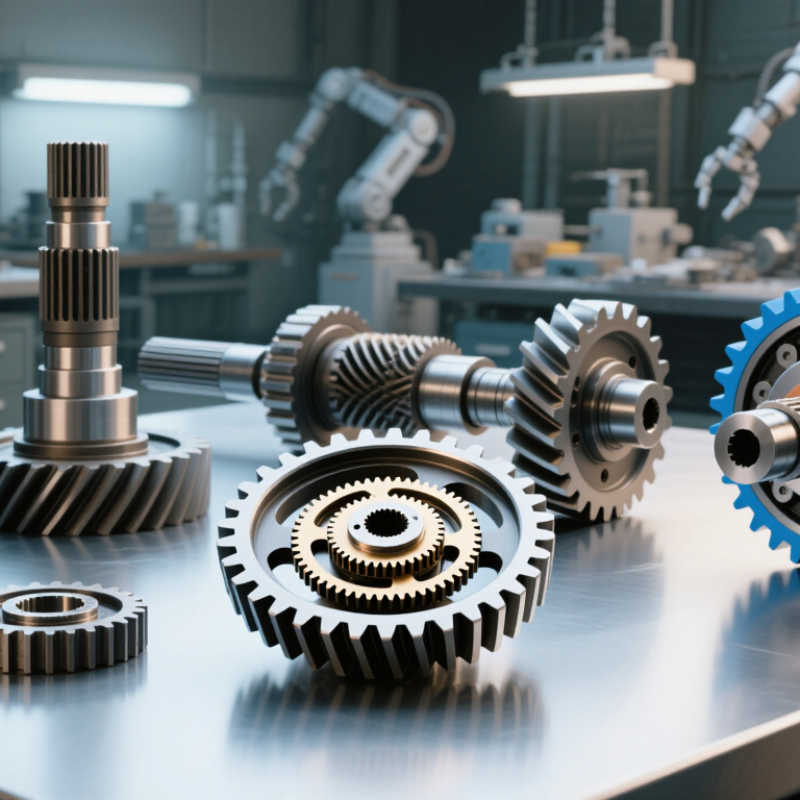
How Gears Transmit Motion and Torque in Robots
In a robot, gears transfer rotation from a motor to a joint or wheel. When small input gears turn larger output gears, speed falls while available torque rises. The gear ratio describes this trade-off. For example, a motor may spin quickly, but a joint needs controlled force to lift an arm. Gear teeth must mesh closely to keep motion predictable. Too much clearance creates backlash; too little can increase friction and wear. Small details matter.
Spur gears are simple and useful for parallel shafts. Planetary gears package several gear contacts into a compact space, often balancing torque capacity and size. Harmonic drives can provide high ratios with low backlash, while bevel gears redirect motion between angled shafts. Worm gears also change direction and may resist back-driving, though they can lose more energy as heat. The best choice depends on payload, speed, noise, space, and duty cycle. A neat calculation can still miss vibration or changing loads in a real robot.
Tips: Check backlash at the joint, not only at the gear. Keep lubricant suitable for the operating temperature, and inspect tooth wear during maintenance. Test under a realistic load. It may reveal an awkward trade-off.

Top Robotic Gear Types in 2026: Typical Transmission Efficiency
How gears transmit motion and torque in robots. The chart compares indicative efficiency ranges for common gear types; actual performance varies with design, load, speed, lubrication, and operating conditions.
Efficiency is the proportion of input mechanical power delivered at the output. Ranges are general engineering reference values, not brand-specific or market-ranking data.
Spur and Helical Gears for Everyday Robotic Drives
What Are the Top Robotic Gear Types in 2026?
Spur and Helical Gears for Everyday Robotic Drives
Spur and helical gears suit many everyday robotic drives, from compact grippers to mobile platforms. Spur gears have straight teeth and work between parallel shafts. Their simple geometry can make them efficient, accessible to inspect, and straightforward to integrate. But tooth engagement can produce noticeable noise, especially at higher speeds. Sudden loads may also expose weaknesses in an undersized gear or support structure.
Helical gears use angled teeth that engage more gradually. This often gives smoother, quieter motion in a joint that moves repeatedly near people or sensitive equipment. The trade-off is axial thrust, which the shaft and bearings must handle. Gear choice alone does not guarantee accuracy. Backlash, shaft alignment, lubrication, and manufacturing quality matter too. A small caveat: quieter motion does not automatically mean better positioning.
Tips: Match the gear to speed, torque, duty cycle, and available space. Check rated loads and bearing arrangements, then test under realistic motion. Listen for changes. Heat and uneven wear can reveal poor alignment or lubrication before failure becomes obvious.
For a lightly loaded mechanism, a spur set may be adequate and easier to maintain. A frequently moving joint may benefit from helical engagement, provided its supports are designed for thrust. Measure backlash at the output, not just at the gear teeth. Tiny gaps can become visible errors at a long robot arm.
Planetary and Harmonic Gears for Compact Precision
What Are the Top Robotic Gear Types in 2026?
Planetary and harmonic gears serve different needs in compact robots. A planetary gearbox places several planet gears around a central sun gear. This arrangement shares load across multiple contact points and keeps the input and output shafts on one axis. In a small robotic joint, that can mean useful torque without a long drive assembly. Multiple stages can provide higher reduction, though added stages may increase friction and complexity. Precision still depends on bearing quality, alignment, lubrication, and manufacturing tolerances. The label alone tells you little.
Harmonic gears use a flexible toothed element, a rigid circular spline, and a wave generator. Their compact shape and high reduction in one stage suit lightweight arms and joints where space is tight. They can also offer low backlash, which helps a robot make small, repeatable movements. That matters. Yet the flexing element experiences repeated strain, and stiffness, heat, and service life deserve attention under real duty cycles. Not always an easy choice. For example, a joint that holds a tool steadily may value stiffness more than minimum size. Engineers should compare measured backlash, torsional stiffness, load, speed, and operating temperature in the actual mechanism. A careful bench test often reveals a tradeoff the datasheet cannot.
What Are the Top Robotic Gear Types in 2026? — Planetary and Harmonic Gears for Compact Precision
| Gear type | Typical reduction range | Backlash and precision | Key advantages | Trade-offs | Common robotic uses |
|---|---|---|---|---|---|
| Planetary | Often about 3:1–10:1 per stage; higher ratios are possible with multiple stages. | Low backlash versions are available; precision depends on design, manufacturing, and preload. | Compact coaxial layout, high torque density, and good load sharing across planet gears. | Multiple stages add length and losses; backlash and wear vary by construction. | Robot joints, mobile robot drives, servo gearboxes, and compact actuators. |
| Harmonic (strain-wave) | Commonly about 30:1–160:1 in a single stage, depending on configuration. | Designed for very low backlash and precise positioning. | High single-stage reduction in a compact, lightweight package; useful where space is limited. | Flexing components can limit stiffness and service life under demanding loads; sensitive to shock and overload. | Compact articulated robot joints, collaborative robots, and precision positioning axes. |
| Cycloidal | Often about 10:1–100:1 per stage, with the exact range determined by design. | Low backlash designs are available; output motion may include small periodic transmission error. | Strong shock-load capacity and high reduction in a compact assembly. | Can have more vibration and noise than some alternatives; precision and smoothness depend on build quality. | Industrial robot joints, heavy-duty actuators, and applications with intermittent shock loads. |
| Spur | Usually modest per stage; higher reductions generally use multiple stages. | Backlash depends on tooth clearance and assembly; precision grades are available. | Simple, efficient, and straightforward to manufacture and maintain. | Parallel shafts and multiple stages may require more space; tooth engagement can be noisy at higher speeds. | Small robot mechanisms, grippers, and auxiliary drives. |
| Bevel | Typically modest per stage; ratios depend on tooth counts and gear geometry. | Precision varies with gear type, mounting accuracy, and adjustment. | Transfers motion between intersecting shafts, often at right angles. | Alignment and mounting are important; high-ratio reduction usually needs additional stages. | Robot wrist mechanisms and compact right-angle transmissions. |
| Worm | Can provide relatively high reduction in a single stage; available ratios vary widely. | Backlash is design-dependent; some arrangements resist back-driving, but this is not guaranteed. | Right-angle drive with substantial reduction in a compact arrangement. | Sliding contact can reduce efficiency and generate heat; lubrication and thermal management matter. | Auxiliary positioning axes, lifts, and mechanisms where controlled holding is useful. |
Reduction ranges are indicative examples, not universal specifications. Actual performance depends on gear geometry, size, materials, manufacturing tolerances, lubrication, operating speed, and load.
Bevel, Worm, and Cycloidal Gears for Specialized Motion
In 2026, robotic gear selection depends on the motion a joint must deliver, not simply its reduction ratio.
Bevel gears redirect torque, often through 90 degrees, making them useful where motors and output shafts meet at an angle. They can transmit motion efficiently, but alignment and tooth contact need careful attention. A small mounting error can create noise or uneven wear.
Worm gears offer compact, high reduction in a single stage. Their sliding contact can generate heat, so lubrication and duty cycle matter, especially in a continuously moving arm. Some designs resist back-driving, but this should never be assumed without checking the gear’s specifications.
Cycloidal gears suit joints exposed to repeated starts, stops, and shock loads. Their eccentric motion and rolling elements can provide low backlash, though performance depends on manufacturing precision and assembly. They are not always the lightest option. A design that looks ideal on paper may feel bulky once the motor, bearings, and housing are included.
Tips: Match the gear to the joint’s load, speed, and available space. Check backlash, heat, lubrication, and expected shock loads. Test the assembled joint under realistic movement; catalog values alone can miss vibration or mounting issues. Keep a little margin. That helps.
How to Match a Gear Type to a Robotic Application in 2026
What Are the Top Robotic Gear Types in 2026?
How to Match a Gear Type to a Robotic Application in 2026
Match the gear to the joint’s actual workload, not just its peak torque. A small inspection arm may need quiet, smooth motion and low backlash. A palletizing axis needs high torque and must handle repeated starts. Check speed, payload, duty cycle, available space, and how precisely the joint must stop. A gear that looks powerful on paper can still overheat during a long shift.
Planetary gears suit compact joints needing strong torque and good efficiency.
Strain-wave gears offer high reduction and low backlash for precise positioning, but their flexible elements need careful load and fatigue assessment.
Spur gears are simple and efficient for less demanding stages.
Bevel gears redirect motion between intersecting shafts, useful when a robot’s layout turns a corner.
Worm gears can provide large reductions, though they may waste more energy; do not assume they will safely hold a load without a brake.
Tips: Compare backlash, rated torque, and thermal limits under your real motion profile. Test repeated moves with the actual payload. Small details matter. A little vibration can reveal poor alignment, but it may also come from the motor or mounting. Gear selection is not always tidy; prototype the joint and revise your assumptions.
Article Source:
At Premium PSU, we are specialists in designing and manufacturing power conversion systems for the industrial market. Our product range includes high reliability power supplies from 50W to 72kW.
PREMIUM PSU
C/ Dolors Aleu, 19-21, 2nd Floor
08908 – Hospitalet de Llobregat
Barcelona-SPAIN
t.+34 93 223 26 85