Why Use a Buck Converter for Efficient Power Management?
In today's rapidly evolving tech landscape, efficient power management is critical. At the forefront of this technology is the buck converter. This device excels in stepping down voltage levels while minimizing energy loss. It plays an integral role in battery-operated devices, offering longer usage times and enhanced performance.
The buck converter achieves high efficiency through a simple switching mechanism. Unlike linear regulators, it efficiently transitions power without generating excessive heat. This process is vital in mobile devices, where every ounce of energy matters. Many designers face challenges maximizing power efficiency. The choice of using a buck converter can often make a significant difference.
It's essential to recognize that not all applications need a buck converter. For some, the complexity may outweigh its benefits. Therefore, understanding your specific power needs is crucial. In the quest for powerful, yet efficient designs, consideration of a buck converter can lead to innovative solutions.
Introduction to Buck Converters and Their Functionality
Buck converters play a crucial role in modern power management, converting higher voltages to lower ones efficiently. These devices utilize a switching regulator to step down voltage while minimizing energy loss. According to recent industry reports, buck converters can achieve efficiencies exceeding 90%. This is especially important in applications where battery life and heat generation are critical concerns.
In various sectors, such as consumer electronics and renewable energy, the demand for lightweight, compact, and efficient power supplies is growing. Buck converters maintain low heat output and prolong battery life significantly. For instance, a study by the International Energy Agency indicates that integrating efficient power converters can reduce energy consumption in electronics by up to 30%. The shift towards electric vehicles also highlights the need for efficient power conversion.
Real-world applications often reveal challenges. While the efficiency rates are impressive, issues like electromagnetic interference can arise. Additionally, in some instances, selecting the proper components becomes complex, and designs may require frequent iterations. Balancing efficiency and performance necessitates careful consideration and testing in diverse applications. These obstacles push engineers towards innovative solutions that promise even greater efficiency in the future.
Advantages of Using Buck Converters in Power Management
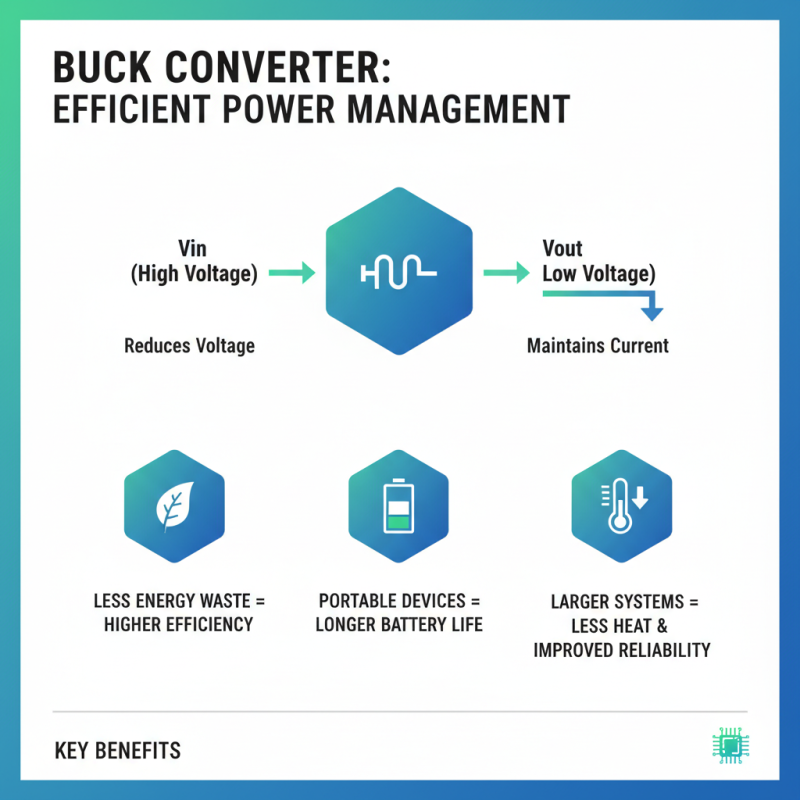
Buck converters are essential in modern power management systems. They efficiently reduce voltage levels while maintaining high current capabilities. This efficiency leads to less energy waste, which is important in many applications. For portable devices, this means longer battery life. For larger systems, it translates into reduced heat production and improved reliability.
One major advantage of buck converters is their compact size. They can fit into tight spaces within devices without sacrificing performance. Their ability to handle high frequencies allows for smaller inductors and capacitors, making designs more flexible. However, it is crucial to choose components wisely. Poor component selection can lead to increased ripple voltage, affecting downstream devices.
Another benefit is their scalability. Buck converters can be tailored for various applications, from small gadgets to larger industrial equipment. Yet, despite their advantages, they require careful design considerations. Improper layout can introduce noise, affecting efficiency. Attention to detail in the design process is vital to harness their full potential.
Applications of Buck Converters in Modern Electronics
Buck converters play a vital role in modern electronics. They efficiently reduce high input voltages to lower output voltages. This feature is critical for battery-powered devices. For instance, smartphones and laptops rely on these converters for extending battery life. Less wasted energy means longer device usage.
In automotive applications, buck converters manage power for advanced systems. Electric vehicles use them to optimize energy consumption. These converters help in controlling motors and lighting systems. In this context, they enhance performance and reliability. However, integration can be challenging, requiring careful design consideration. A poorly designed buck converter can lead to inefficiencies and heat issues.
Consumer electronics also benefit greatly from buck converters. They are found in gaming consoles and smart home devices. These converters help in providing stable power to various components. Yet, not all applications use them effectively. Designers must balance efficiency with cost and complexity. It's an ongoing challenge in the fast-evolving tech landscape.
Efficiency of Buck Converters in Power Management
Comparison of Buck Converters with Other Power Regulation Methods
When considering power regulation methods, buck converters stand out for several reasons. They efficiently step down voltage while maintaining high power density. This is particularly advantageous where size and weight matter. Buck converters can achieve efficiency levels above 90%, which significantly reduces heat generation. This also prolongs the lifespan of components in electronic devices.
In contrast, linear voltage regulators, though simpler to implement, waste energy as heat. They can be less efficient, especially in high voltage drop scenarios. This inefficiency often requires heatsinks to manage excess heat, complicating design. In certain applications, this added complexity can be a drawback.
Moreover, switching converters introduce electromagnetic interference (EMI), which needs careful filtering. This aspect can be tricky, as it may not be perfect in all designs. Users must weigh these factors when choosing between buck converters and linear models. The choice often hinges on specific application requirements, efficiency needs, and design constraints. Understanding these subtleties can lead to better power management solutions.
Why Use a Buck Converter for Efficient Power Management? - Comparison of Buck Converters with Other Power Regulation Methods
| Power Regulation Method |
Efficiency (%) |
Cost (USD) |
Complexity |
Heat Generation |
| Buck Converter |
85-95 |
10-30 |
Moderate |
Low |
| Linear Regulator |
40-60 |
5-20 |
Low |
High |
| Boost Converter |
80-90 |
15-35 |
High |
Moderate |
| Flyback Converter |
70-85 |
20-50 |
High |
Moderate to High |
| Charge Pump |
70-80 |
10-25 |
Low |
Low |
Future Trends in Buck Converter Technology and Power Efficiency
The future trends in buck converter technology are promising and essential for power efficiency. According to a recent report by Research and Markets, the global buck converter market is poised to grow at a CAGR of 7% through 2025. This growth indicates a rising demand for energy-efficient solutions across various sectors, including automotive and consumer electronics. Improved thermal management systems are already becoming standard, allowing for more compact designs without sacrificing performance.
New materials, like silicon-carbide and gallium-nitride, are enhancing efficiency. These materials enable higher switching frequencies, which can increase the power density of converters. A recent study indicated that buck converters using these materials can achieve efficiency levels exceeding 98%. However, challenges remain. Designers often overlook the importance of electromagnetic interference (EMI) and how it affects performance. Addressing these issues can lead to better integration in complex systems.
On the horizon, smart buck converters are emerging, equipped with wireless communication capabilities. They can optimize power management in real-time. However, the complexity of these systems poses questions about reliability and maintenance. As the market evolves, designers need to balance innovation and practicality. The quest for efficiency continues, but there’s still much to consider. It can be a daunting journey for engineers navigating these advancements.