
What Is a High Mast Street Light?
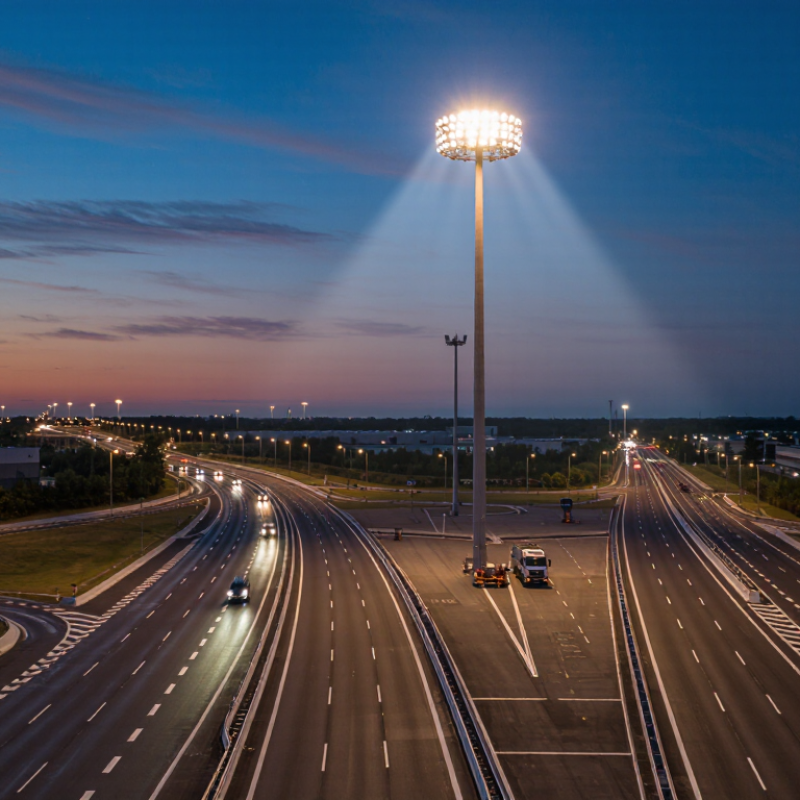
A High Mast Street Light is a powerful outdoor lighting system mounted on a tall pole, often between 20 and 40 meters high. It illuminates wide areas with fewer poles. You may see these systems along highways, large intersections, ports, airports, and industrial yards.
Its purpose is more than brightness. A well-designed High Mast Street Light should provide suitable illuminance, balanced uniformity, controlled glare, and reliable visibility. Peter R. Boyce, a respected lighting researcher, states, “The purpose of lighting is to enable people to see.” This principle remains important when engineers select LED wattage, beam angles, pole spacing, and mounting height. Photometric software can model these factors before installation. Field measurements should still verify the result.
Real conditions are less tidy. Rain can reduce visibility. Dust can weaken optical performance. Strong wind can affect tall structures. Maintenance vehicles also need safe access. A design that looks efficient on paper may create dark patches or uncomfortable glare on the road. That assumption can fail.
This article explains how a High Mast Street Light works, where it fits best, and which technical details deserve attention. It will examine LED fixtures, lighting distribution, structural safety, energy use, maintenance, and project costs. Local road-lighting standards must guide the final design. No single pole height suits every site. Careful planning matters. Even experienced teams can overlook pedestrian movement, nearby homes, or reflective road surfaces. Good lighting is practical, measurable, and open to revision.
Definition and Core Features of High Mast Street Lights
What Is a High Mast Street Light?
A high mast street light is an outdoor lighting system mounted on a tall pole, usually 15 metres or higher. Its elevated position spreads light across wide areas, such as highways, ports, stadium approaches, and large junctions. The pole may support several luminaires arranged around a crown or lowering frame. This design reduces the number of poles needed, but it increases structural and maintenance demands.
Core features include high optical efficiency, wide beam distribution, corrosion-resistant materials, and reliable electrical protection. The U.S. Department of Energy’s solid-state lighting reports show that modern outdoor LED luminaires can exceed 100 lumens per watt, helping reduce energy use compared with older discharge systems. The International Energy Agency reports that lighting consumes about 15% of global electricity, so efficient road lighting remains a practical energy-saving opportunity. However, efficiency alone does not guarantee good visibility.
Engineers should check mounting height, wind loading, glare control, uniformity, and maintenance access. EN 13201 road-lighting guidance emphasizes measurable factors such as average luminance and lighting uniformity. In field inspections, dark patches often appear when beam angles are selected without accurate roadway measurements. That mistake is easy to make. Smart controls, dimming schedules, and photocells can lower operating costs, yet poor settings may create unsafe transitions or excessive darkness. Height is only one part of the design.

How High Mast Street Lights Are Designed and Installed
What Is a High Mast Street Light?
How High Mast Street Lights Are Designed and Installed
A high mast street light uses a tall pole, usually 20 to 40 meters high, with several luminaires near its top. It illuminates wide areas, including highways, ports, interchanges, and logistics yards. Design begins with road classification, traffic speed, pole spacing, and required lighting levels. Engineers apply CIE 115:2010 and EN 13201 guidance when evaluating illuminance, uniformity, glare, and light spill. Photometric software tests different mounting heights and beam angles before construction. This matters because the International Energy Agency’s Energy Efficiency 2024 report identifies lighting as roughly 15% of global electricity use. The U.S. Department of Energy also reports that LED roadway upgrades can reduce energy consumption by about 50% or more, depending on existing equipment and controls.
Structural design is equally important. Engineers calculate wind pressure, pole deflection, fatigue, corrosion exposure, and foundation capacity. Soil testing determines the foundation depth and anchor-cage arrangement. Galvanized steel, sealed electrical compartments, surge protection, and reliable earthing support long service life. Details matter. Installation teams survey underground utilities, prepare the foundation, erect the pole with a crane, and torque every anchor nut carefully. They then level the pole and aim each luminaire using the approved photometric plan.
Commissioning should include insulation tests, control checks, and measured illuminance at road level. Measure twice. A design can look perfect on paper but still produce dark patches after installation. Field conditions, nearby trees, and unexpected reflective surfaces can change results. Scheduled cleaning and lowering-device inspections help preserve performance, although maintenance planning is often underestimated.
Main Components and Lighting Technologies
What Is a High Mast Street Light?
A high mast street light uses a tall pole, usually 12 to 40 meters high, to illuminate wide areas. Typical locations include highways, ports, airports, and large intersections. Its main components include a steel pole, foundation, lifting crown, winch system, power cable, luminaires, and surge protection. The crown lowers for maintenance, but this mechanism still needs careful inspection. A small cable fault can stop an entire lighting point.
LED is now the dominant lighting technology because it provides strong efficiency, long service life, and precise beam control. The U.S. Department of Energy reports that commercial LED products can exceed 150 lumens per watt, depending on design and operating conditions. The International Energy Agency also states that LED lighting can use up to 75% less energy and last up to 25 times longer than incandescent lighting. For high mast applications, asymmetric optics can push light toward road lanes instead of nearby buildings. Dimming, photocells, and networked controllers can reduce output during quiet hours. Still, higher efficiency does not automatically mean better visibility. Glare, poor pole spacing, and excessive color temperature can weaken the result.
Tips: Specify photometric testing, surge protection, and a realistic maintenance plan. Check wind loading and foundation conditions before selecting pole height. A lower wattage fixture may look attractive, but under-lighting creates safety concerns. In practice, lighting calculations should be compared with nighttime field observations. That step is often missed. The CIE recommends evaluating brightness, uniformity, glare, and visual comfort together, rather than trusting one performance number.
Common Applications in Large-Scale Outdoor Areas
What Is a High Mast Street Light?
Common Applications in Large-Scale Outdoor Areas
A high mast street light uses a tall pole, often 20 to 40 metres high, to illuminate wide outdoor spaces. Multiple luminaires sit near the top, reducing the number of poles needed. This arrangement suits ports, intermodal yards, airports, stadium approaches, mining sites, and major parking areas. It also keeps maintenance activity away from busy ground zones. Safety depends on more than brightness. Designers check mounting height, beam distribution, glare, uniformity, wind loading, and emergency access.
Large sites need measurable performance. The International Energy Agency reports that lighting consumes about 15% of global electricity in Energy Efficiency 2024. Efficient high-mast systems can reduce operating demand, especially when dimming follows traffic or scheduled activity. The U.S. Department of Energy’s 2023 Solid-State Lighting R&D Opportunities report identifies 200 lumens per watt as an important future performance target. That figure is not a promise for every installed product. Site conditions matter. Dust, rain, pole vibration, and poor aiming can erase expected gains. A perfectly uniform layout is not always the best layout. Careful photometric modelling should be checked against actual night-time visibility. Sometimes, fewer brighter poles create harsher shadows. That deserves a second review.
What Is a High Mast Street Light? - Common Applications in Large-Scale Outdoor Areas
| Application Area | Typical Mast Height | Typical Luminaire Arrangement | Typical Average Illuminance | Recommended Light Distribution | Primary Lighting Objective |
|---|---|---|---|---|---|
| Expressways and Interchanges | 25–40 m | 4–12 LED luminaires per mast | 15–30 lx | Asymmetric, roadway-focused | Provide uniform visibility across multiple lanes while reducing the number of roadside poles. |
| Large Parking Areas | 20–35 m | 4–8 LED luminaires per mast | 10–20 lx | Wide, symmetric or area distribution | Cover broad open spaces with fewer foundations and less visual obstruction. |
| Ports and Container Yards | 25–45 m | 4–16 LED luminaires per mast | 20–50 lx | Long-throw, controlled asymmetric | Illuminate storage blocks, loading zones, and vehicle routes while limiting glare to operators. |
| Airports and Aircraft Aprons | 25–45 m | 4–12 LED luminaires per mast | 15–30 lx | Precisely aimed area distribution | Support ground handling and vehicle movement without creating excessive glare or visual interference. |
| Industrial Complexes | 20–40 m | 4–10 LED luminaires per mast | 15–30 lx | Wide-area, low-glare distribution | Improve visibility around internal roads, yards, material handling areas, and security zones. |
| Sports and Event Grounds | 20–40 m | 4–12 LED luminaires per mast | 20–75 lx | Symmetric, uniform area distribution | Deliver even lighting for circulation, crowd movement, parking, and non-broadcast activities. |
| Toll Plazas and Checkpoints | 20–30 m | 4–8 LED luminaires per mast | 20–50 lx | Controlled symmetric distribution | Maintain clear visibility of lanes, booths, signs, and approaching vehicles. |
| Logistics and Distribution Centers | 20–35 m | 4–10 LED luminaires per mast | 15–30 lx | Wide, asymmetric area distribution | Light truck courts, loading bays, circulation lanes, and outdoor storage areas efficiently. |
Note: The figures shown are typical planning ranges for high-mast outdoor lighting. Final mast height, luminaire quantity, illuminance, spacing, glare control, and uniformity should be confirmed through a site-specific photometric design and applicable local lighting standards.
Benefits, Limitations, and Maintenance Requirements
What Is a High Mast Street Light?
Benefits, Limitations, and Maintenance Requirements
A high mast street light uses a tall pole, often 20 to 40 meters high, to illuminate wide areas. It suits highways, ports, junctions, industrial yards, and large parking zones. One pole can cover more ground than several shorter poles. This reduces visual clutter and may simplify cable routing. Modern LED fixtures can improve visibility while using less energy. Uniform lighting also helps drivers notice lane edges, vehicles, and pedestrians.
The height creates limitations. Strong wind can produce vibration, while salt, dust, and moisture can accelerate corrosion. A wider reach may also increase glare if optics are poorly selected. Installation needs careful photometric planning, stable foundations, reliable grounding, and suitable surge protection. Maintenance is less convenient than with low poles. Technicians may need a lowering system, lifting equipment, or a service platform. Regular inspections should check anchor bolts, welds, coatings, cables, lenses, and light output. I would not treat energy savings as guaranteed. Dirty lenses, failed drivers, or poor aiming can quickly reduce performance.
Tips: Schedule inspections at least twice yearly, with extra checks after severe weather. Clean lenses before measuring illumination. Test the lowering device, winch, and safety locks under controlled conditions. Record corrosion, electrical faults, and replaced parts. Use qualified personnel and follow the site’s safety procedures. Small defects are easy to overlook. They can become expensive failures.
Article Source:
At Premium PSU, we are specialists in designing and manufacturing power conversion systems for the industrial market. Our product range includes high reliability power supplies from 50W to 72kW.
PREMIUM PSU
C/ Dolors Aleu, 19-21, 2nd Floor
08908 – Hospitalet de Llobregat
Barcelona-SPAIN
t.+34 93 223 26 85