
2026 Best AC to DC Inverter Types for Global Buyers
Choosing the right ac to dc inverter in 2026 requires more than comparing wattage and price. Global buyers must examine input voltage, output stability, efficiency, cooling, isolation, and certification requirements. A unit designed for a 120 V market may fail in a 230 V installation without suitable input protection. Small details matter.
The term “ac to dc inverter” is widely used in product listings, although many engineers prefer “AC-DC converter” or “switching power supply.” This distinction can prevent costly misunderstandings. Our guide compares common types, including isolated flyback, forward, LLC resonant, and power-factor-correction designs. Each topology serves different applications, from compact chargers to industrial control cabinets. Expect practical observations from real installation conditions, not only laboratory specifications.
Heat changes performance.
A reliable selection also requires attention to datasheets, derating curves, connector quality, standby consumption, and service support. Buyers should verify EMC, safety, and regional conformity documents before purchase. Certification names alone do not guarantee suitability. Installation environment matters too. Dust, humidity, vibration, and limited airflow can shorten operating life, even when the rated output appears adequate.
Some recommendations may remain imperfect because manufacturers publish inconsistent test methods. That limitation deserves honest consideration. Use measured efficiency, verified thermal data, and advice from qualified electrical professionals whenever possible. The following overview helps procurement teams, engineers, and distributors compare 2026 AC-to-DC solutions with clearer expectations and fewer avoidable assumptions.
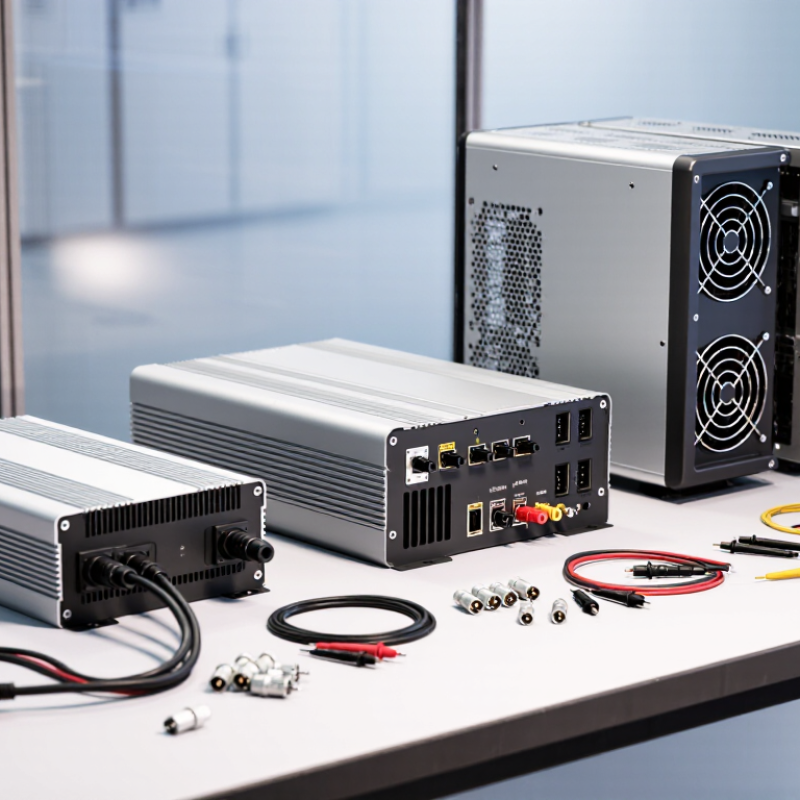
AC-to-DC Conversion Explained: Rectifiers, SMPS, PFC, and Inverters
AC to DC conversion starts with a rectifier. It changes alternating voltage into pulsating direct voltage. A bridge rectifier is common in compact power supplies. A capacitor then smooths the waveform, but it does not remove every ripple. Designers add regulation for stable output. For global buyers, check input range, frequency, isolation, efficiency, and thermal limits. A 100–240 V input can simplify regional deployment. Yet the label alone proves little.
An SMPS switches at high frequency, reducing transformer size and improving control. It can deliver steady 12 V, 24 V, or other outputs. PFC shapes input current and can reduce wasted reactive demand. This matters in factories with many chargers or motor loads. An inverter normally converts DC back to AC, not AC to DC. The terms are often mixed in product listings. Confirm the power-flow diagram before purchasing. Testing under startup load is essential. Cold numbers can mislead.
Tips: Compare continuous power, surge power, ripple, and standby consumption. Ask for safety test reports and clear operating temperatures. Inspect terminal spacing and enclosure ventilation. If the unit feeds sensitive controls, measure ripple with a proper oscilloscope. I would not trust efficiency claims without test conditions. A small mismatch can cause heat, noise, or early failure. Leave headroom, but avoid oversized equipment that runs inefficiently.
2026 Best AC to DC Inverter Types for Global Buyers - AC-to-DC Conversion Explained: Rectifiers, SMPS, PFC, and Inverters
| Technology Type | Primary Function | Typical Input | Typical Output | Typical Efficiency | Power Factor Consideration | Best-Fit Applications |
|---|---|---|---|---|---|---|
| Uncontrolled Diode Rectifier | Converts AC voltage into a pulsating DC voltage using diodes. | Single-phase or three-phase AC | Unregulated DC; approximately 1.35 × line-to-line RMS voltage for a three-phase bridge before load and diode-drop effects | Approximately 90–98%, depending on power level and operating conditions | Usually moderate to low without additional power-factor correction because the input current is non-sinusoidal. | Basic DC supplies, battery chargers, motor drives, and front ends where cost and simplicity are priorities. |
| Controlled Rectifier | Provides rectification with adjustable average DC output through thyristors or other controlled semiconductor devices. | Single-phase or three-phase AC | Adjustable DC voltage, generally lower than the maximum uncontrolled-rectifier output | Approximately 85–97%, depending on switching frequency, load, and control method | Input displacement factor and harmonics can worsen at reduced output voltage; filtering may be required. | High-power industrial DC systems, electrochemical equipment, and legacy variable-speed drive architectures. |
| Linear AC-to-DC Supply | Uses a transformer, rectifier, filter capacitor, and linear regulator to create a stable DC output. | AC mains, commonly 50 or 60 Hz | Low-voltage regulated DC | Typically 30–60% | Normally poor to moderate at the input because of the transformer and capacitor-input rectifier. | Low-noise instrumentation, audio circuits, laboratory equipment, and low-power control electronics. |
| Isolated SMPS | Rectifies AC, switches at high frequency, transfers energy through a transformer, and regulates the DC output. | Wide-range AC input, often 85–264 V AC for universal-input designs | Regulated isolated DC, such as 5 V, 12 V, 24 V, or other specified outputs | Approximately 80–95% | Without active PFC, power factor is commonly lower at medium and high power, with greater harmonic current. | Industrial controls, telecom equipment, embedded systems, consumer electronics, and compact adapters. |
| Non-Isolated Buck SMPS | Steps a higher DC-link voltage down to a lower regulated DC voltage without galvanic isolation. | Rectified DC or a controlled DC bus | Lower regulated DC output | Approximately 90–98% | Power factor is determined mainly by the upstream AC front end; it does not provide input PFC by itself. | Point-of-load converters, LED drivers, auxiliary rails, and systems where isolation is not required. |
| Boost PFC | Shapes the AC input current to follow the input voltage waveform and raises the rectified voltage to a controlled DC bus. | Single-phase or three-phase rectified AC | Regulated high-voltage DC bus; commonly around 380–400 V DC in universal-input single-phase systems | Approximately 95–99% | Can achieve a power factor close to unity when correctly designed and loaded. | Higher-power SMPS, computers, lighting systems, battery chargers, and equipment subject to harmonic-current limits. |
| Totem-Pole or Bridgeless PFC | Uses a reduced-loss front-end arrangement to combine rectification and active power-factor correction. | Single-phase AC, typically universal input | Regulated high-voltage DC bus | Approximately 97–99% in optimized designs | High power factor and low input-current distortion are achievable with suitable control. | High-density data-center power supplies, high-power chargers, and advanced energy-efficient power converters. |
| Three-Phase Active Front End | Converts three-phase AC to a controlled DC bus while regulating current and, in some systems, enabling bidirectional power flow. | Three-phase AC | Regulated DC bus, commonly several hundred volts or more | Approximately 95–99% | Excellent power factor and low current distortion are possible with closed-loop control. | Industrial drives, regenerative systems, electric-vehicle charging infrastructure, and high-power test equipment. |
| AC-to-DC Converter with DC-AC Inverter Stage | First creates a DC link from AC, then converts DC back to controlled AC using an inverter bridge. | Single-phase or three-phase AC | Variable-frequency or regulated AC output; a DC output may also be available from the intermediate bus | Approximately 90–98% for the complete conversion chain, depending on rating and switching technology | Usually includes active rectification or PFC when low input harmonics and controllable power factor are required. | Variable-frequency drives, uninterruptible power systems, grid-connected converters, and motor-control platforms. |
| Bidirectional AC-DC Converter | Transfers energy between an AC grid and a DC bus or battery, supporting both rectification and inversion. | Single-phase or three-phase AC | Controlled DC charging and AC regeneration or grid export | Approximately 94–99% | High power factor and low harmonic distortion are achievable in grid-connected operation. | Vehicle-to-grid systems, energy storage, regenerative test systems, and renewable-energy power conversion. |
Related Posts
-
2026 Top AC DC Power Supply Manufacturers for Global Buyers
-
Top AC to DC Power Converters for Global Buyers?
-
Best AC DC Adapter Options for Global Buyers in 2026?
-
10 Essential Tips for Choosing the Right Switching Power Supply
-
Top China Switching Power Supply Manufacturers for Global Buyers?
-
What is an AC to DC Converter and How Does it Work?